Link Placeholder - © Hasa Avocats 2026 - Website Tatianalab

Hasa Attorneys, a distinguished law firm with profound expertise in Canadian immigration law, specializes in facilitating the complex process of family sponsorship. Our commitment is to provide clients with personalized and thorough legal guidance, ensuring a seamless journey towards family reunification in Canada.
Understanding Family Sponsorship
Family sponsorship is a cornerstone of Canada’s immigration policy, designed to reunite families. This program allows Canadian citizens and permanent residents to sponsor eligible family members, including spouses, common-law partners, dependent children, and parents or grandparents, to become permanent residents of Canada. The program underscores the value of family and aims to strengthen the social and cultural fabric of Canadian society.

Quebec Application Caps
The Quebec government has implemented a cap on the number of family sponsorship applications that will be accepted until June 2026. A limited number of applications will be considered, so it is crucial to submit your sponsorship application as soon as possible. The imposed caps are as follows:
Once the maximum number of applications is reached, no additional applications will be processed until June 2026. The period for submitting family sponsorship applications is limited, and we anticipate that capacity will soon be reached. We strongly encourage potential sponsors to complete and submit their applications immediately to ensure their application is processed before the cap is reached.
Categories of Family Sponsorship
Sponsorship from Within Canada
Sponsoring a family member from within Canada, also known as “inland sponsorship,” allows the sponsored individual to reside in Canada while their application is being processed. This type of sponsorship offers the possibility to work or study legally in Canada during the processing of the application under certain conditions. It is particularly essential that the sponsored individual has maintained a legal status in Canada, whether as a visitor, student, or worker at the time the application is submitted.
Family members sponsored from within Canada may benefit from certain temporary resident permits, such as:
Sponsorship from Outside Canada
Sponsorship from outside Canada applies to family members living abroad. Applications submitted through this route are generally processed by visa offices abroad. The sponsored individual will have to wait for the approval of the application before they can move to Canada as a permanent resident. This process can be longer than inland sponsorship, but it also allows the sponsored individual to stay with their loved ones in their home country during the processing of the application.

Application Process
The application process for family sponsorship involves several detailed steps, including eligibility assessment, gathering necessary documentation, and submission of the application. Hasa Attorneys will guide clients through each step:
Importance of Supporting Evidence for the Application
Providing strong evidence is essential for the success of a family sponsorship application. The evidence must demonstrate:
Ensure that all evidence is clear, complete, and well-organized to avoid delays or refusals.
Quebec-Specific Considerations
Sponsorship within Quebec comes with specific obligations towards both the government and the sponsored individual. Sponsors enter into a contractual commitment with the Quebec government, ensuring that the sponsored family members will not become a financial burden on the society.
Once the sponsor’s eligibility is confirmed by Immigration, Refugees, and Citizenship Canada (IRCC), the process in Quebec proceeds to the following steps:
Once the CSQ is obtained, the application will continue to be processed at the federal level for the issuance of permanent residence.
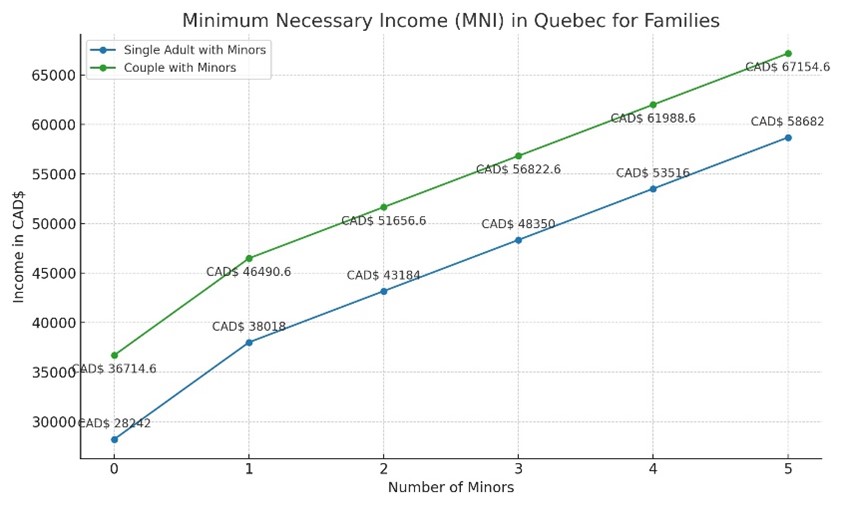
The Minimum Necessary Income for sponsors in Quebec:
In Quebec, the Minimum Necessary Income for sponsors depends on the family size, including both the sponsor’s own family and the sponsored persons. These numbers change and are routinely updated by the Quebec Government, but here are the numbers as of June 2024. The basic income required is $28,242 for a single individual. That amount increases with each additional family member being sponsored. For sponsoring persons under 18, an additional amount of $9,776 for one person and $15,493 for two is required, with an increment of $5,166 for each additional minor. For more details, you can visit the official Quebec government website.
Integration into Quebec society
For integration into Quebec society, the Government emphasises the importance of understanding French and adapting to Quebec’s social norms. It suggests prospective residents should enhance their French language skills for effective communication and integration into the local community. Additionally, adapting to Quebec involves familiarizing oneself with the province’s culture, values, and societal expectations to ensure a smooth transition into the community. For more detailed guidance on these aspects, the document recommends specific resources and programs available for newcomers in Quebec.
Fees and Estimated Time
Navigating the family sponsorship process, especially within Quebec, requires a thorough understanding of the legal obligations, application steps, and associated costs. Hasa Attorneys provide expert guidance throughout this journey, ensuring a smooth and informed pathway to family reunification in Canada. If you would like to discuss your sponsorship application further, please contact us to book a consultation.
Welcome to Hasa Attorneys, a distinguished immigration law firm nestled in the heart of Montreal. Specializing in immigration, we strive to guide asylum seekers through a sometimes complex process. Our dedicated team combines experience and compassion, ensuring each client receives personalized and effective legal support. In this article, we will explore the journey of asylum seekers in Canada, highlighting eligibility criteria and the various steps leading to protected person status.
Understanding Refugee Status in Canada
In Canadian and international law, a refugee is defined as someone who is outside their home country or the country they normally live in and is unable to return due to a well-founded fear of persecution based on race, religion, political opinion, nationality, or being part of a particular social group. Refugee status in Canada is granted to those meeting that definition of a refugee. It also applies to persons in need of protection, who would face dangers such as torture, or risk to life, or cruel treatment if returned to their home country. This status offers crucial legal protection, preventing individuals from being sent back to situations where their safety and rights are at risk.
Eligibility for Refugee Status
Gaining refugee status in Canada involves a nuanced process that carefully evaluates an individual’s circumstances against specific eligibility criteria. To embark on this journey, understanding these prerequisites is vital:

Navigating through these criteria requires a deep understanding of legal nuances and the implications of each condition. It’s not just about meeting the basic requirements but about clearly articulating the threats and persecutions faced in the country of origin, aligning with Canada’s protective stance for human rights.
The Asylum Claim
Applying for refugee status in Canada is a critical step toward protection and safety for those fleeing persecution. The process is designed to be accessible, offering two main avenues for making a claim: at a port of entry upon arrival in Canada, or from within Canada if you have already entered the country.
At a Port of Entry

Upon arrival at any Canadian port of entry—be it an airport, seaport, or land border—you are entitled to make a claim for refugee protection. This process starts with an eligibility interview conducted by an officer from the Canada Border Services Agency (CBSA), during which you’ll complete an application package and provide necessary biometrics like fingerprints and photographs.
After Arriving in Canada
This section outlines the steps for making a claim from within Canada, emphasizing the importance of a complete application, the online submission process, and the role of representatives in assisting with the application. Whether you’ve recently arrived or have been in the country for some time, understanding this process is key to successfully navigating the Canadian refugee claim system.
Arguing your case
Once submitted, if deemed eligible, your claim will be referred to the Refugee Protection Division (RPD). You will receive a Refugee Protection Claimant Document and a Confirmation of Referral letter, along with the Claimant’s Guide for further steps.
Basis of Claim (BoC)
A crucial next step is submitting a completed Basis of Claim (BOC) Form for each family member within 15 days of referral. When applying for refugee status in Canada, articulating the foundation of your claim is pivotal. The Basis of Claim (BoC) Form is an important document that enables you to outline your background, family circumstances, and the specific reasons you’re seeking refugee protection. This form is designed to capture the essence of your claim through detailed inquiries. Key Sections of the BoC form include:
Providing a thorough and honest account within the BoC Form is not just about fulfilling a procedural requirement; it’s about conveying your story in a manner that underscores the urgency and legitimacy of your plea for refuge. This documentation is pivotal in the assessment process, where the details of your narrative can significantly influence the outcome of your claim.
Gathering and Submitting Evidence
When making a refugee claim in Canada, substantiating your claim with concrete evidence is crucial. This evidence provides the Immigration and Refugee Board (IRB) with the necessary context to assess your claim accurately. Here’s how to gather and submit this vital information:
Remember, the quality and relevance of your evidence can significantly impact the outcome of your claim. It’s not just about the quantity of documents but their ability to convincingly illustrate your need for protection under Canada’s refugee and asylum laws.
Attending Your Hearing
The refugee hearing is a pivotal moment in the application process, offering you the platform to present your case in detail. This section provides an overview of what to expect during the hearing and how to prepare effectively. Here is what you can expect at your hearing:

Proper preparation, along with gathering substantial evidence are key to articulating your case compellingly.
Receiving Your Decision
After your refugee hearing, the process of awaiting a decision begins. This crucial phase determines the next steps in your journey towards safety and residency in Canada. Here’s an overview of what happens post-hearing and the possible outcomes you might face.
Post-Hearing Process
Possible Outcomes:
Outcomes can be broadly categorized as negative or positive.
After You Apply
After submitting your refugee claim in Canada, there are several important steps and options to consider as you await the decision. This period involves managing your existing documents, exploring work and study opportunities, and ensuring your claim remains secure against fraud.
Work and Study Permits
Both work and study permits represent avenues through which refugee claimants can constructively engage and integrate into Canadian society during the processing period of their claims. It’s essential to stay informed about the application processes for these permits to make the most of your time in Canada while awaiting your claim’s outcome.
For comprehensive support and guidance through this complex process, consider partnering with Hasa Attorneys after you have made your claim as a refugee. Our experience in immigration law ensures that every step of your journey is navigated with precision and care, maximizing your chances of a favorable outcome and a new beginning in Canada.
Welcome to Hasa Attorneys, nestled in the vibrant core of Montreal, a city celebrated for its academic excellence. Our firm stands as a pillar of legal acumen, specializing in unwinding the complex skein of Canadian immigration law for international students. We pride ourselves on crafting bespoke solutions that cater to the unique educational ambitions of our clients, bolstered by our comprehensive understanding of immigration legislation and procedures.
Understanding Canadian Study Permits
A Canadian study permit is the golden ticket for international students, a crucial document that legally endorses their academic pursuits in Canadian institutions. This permit is the bedrock of their academic journey, ensuring their educational endeavors are in line with Canada’s immigration standards.
The Canadian Educational Landscape
Canada’s educational landscape is a rich mosaic, beckoning students with its inclusive ethos and globally recognized academic credentials. It is a nurturing ground for innovation and intellectual growth, offering a wealth of opportunities for personal and scholarly development.

Types of Study Permits
The study permit system is designed to reflect the diverse academic pathways of students:
Specialized Study Provisions
In line with its flexible immigration policies, Canada provides specific provisions for students under various scenarios:
Steps to Obtaining a Study Permit
For students applying for a study permit from outside of Quebec, the process is managed by Immigration, Refugees and Citizenship Canada (IRCC) and does not require a Certificate of Acceptance of Quebec (CAQ). Here are the key steps you would need to follow:
Additional Steps to Study in Quebec
Studying in Quebec involves additional considerations, given its unique cultural and linguistic heritage. Accordingly, if applying to study in Quebec you will need to follow the following steps:
Preparing for Studies in Canada
Prospective students should prepare for their academic journey by acquainting themselves with Canada’s cultural and educational systems, language proficiency requirements, and financial planning for their studies.
Settling in Canada as a Student
The transition to student life in Canada encompasses finding accommodation, understanding healthcare, and engaging with campus life. Canadian educational institutions offer extensive resources to help international students settle in.

Hasa Attorneys is your steadfast guide through the Canadian study permit process. Whether you’re planning to study in Quebec or another province, we offer the know-how to ensure a smooth and successful academic journey. Contact Hasa Attorneys for a detailed consultation and begin your educational adventure in Canada with a team that is committed to your success.
Link Placeholder - © Hasa Avocats 2026 - Website Tatianalab